Deep tissue, trigger point, Graston, foam rolling, myofascial release — if you've been through the soft-tissue menu and the tightness keeps returning, it isn't that bodywork doesn't work. It's that each of those applies one force, one way, across the surface. Delos applies precise, oscillating pressure and shear into the tissue itself, from multiple directions, calibrated in real time. That is the only thing we do.
A focused first visit to map what’s driving your pain and stiffness — and show you, on your own tissue, what makes this different.$50, credited in full toward your treatment plan.
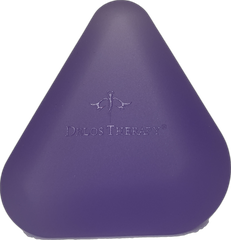
Your evaluation includes a Delos Gumdrop — a patented design, deliberately asymmetrical, engineered to find the tightness a round tool rolls over. We’ll show you how to use it between sessions. Yours to keep.
Each of these helps many people, and each does one piece. But work that glides along the muscle, holds pressure in one spot, or scrapes the surface with a tool can't remodel a three-dimensional restriction with precision — or change the tissue in real time as it responds.
Gliding strokes along the muscle. They warm and soothe, but sliding across the surface can't put calibrated, multi-directional pressure into a specific restriction.
Gentle, sustained pressure, held in place. A static hold can't drive the press-and-release rhythm that restores glide and flushes the tissue.
Pressure into a spot, or body weight rolled along the muscle. Useful as a general reset, but broad, single-direction, and — for foam rolling — usually brief.
A rigid instrument worked across the surface, on a set protocol. It can't read the tissue by feel, or reach the densification deep inside the muscle.
Delos begins where those leave off — precise, multi-directional pressure and shear, calibrated in real time to the tissue in front of it.
Delos Therapy applies precise, oscillating pressure and shear — a multi-directional micro-stretch of the knotted, hyper-contracted fibers producing your pain and stiffness, calibrated in real time by feel.
It releases that tightness and congestion and is designed to restore pliability, returning you to what the pain has kept you from. Many clients feel a difference within the first sessions — not after months.
Every visit is one-on-one, in a private treatment room, with a therapist trained specifically in Delos Therapy.
We locate the contracted tissue driving the pain and treat it directly, rather than working around it.
Most people who come to us have already tried the conventional routes. That is precisely who the method was refined for.
The evaluation maps exactly what's driving your pain and lays out the specific course of treatment to resolve it. You leave with a clear plan for a problem that's felt unsolvable — and most clients feel real change as they work through it.
Nearly every soft-tissue approach applies one force in one way — a glide, a hold, a scrape, a roll. Delos applies oscillating pressure and shear, in multiple directions, calibrated in real time. That combination does four things at once that a single, static, or surface technique cannot.
A muscle restriction isn't flat — the densified tissue binds the fiber bundles in every direction at once. Freeing it takes multi-directional pressure and shear — worked into the tissue and matched to each direction the restriction holds. A single-direction stroke, or a press held in one spot, reaches only part of it.
Press hard and hold, and the nervous system reads it as a threat and guards — the muscle braces and won't let go. The oscillating rhythm doesn't provoke that response; it eases the nervous system off its guard, so the tissue releases instead of bracing against you.
Press, release, repeat. Each press briefly restricts blood flow; each release floods the tissue with fresh, oxygenated blood. That ischemia-reperfusion cycle drives metabolic adaptation and flushes waste from congested tissue — something a sustained hold, which is only sustained compression, cannot do.
Muscle and fascia are built to glide over one another. Where the fluid between the layers has thickened and lost that slide, oscillating pressure and shear decrease its viscosity — restoring the lubricating film that lets the layers move freely again.
This is how the method works as the current science best understands it — the leading explanation, not a finished one. The deeper structural changes over a full course of treatment are exactly what our university research is studying now.
This is the line between Delos and everything else, and it starts with what a tight muscle actually is. The real problem lives in the intramuscular fascia — the connective tissue woven throughout the muscle, between and around the fibers, that lets its layers slide and move. Specifically, the sheath around each bundle of fibers, the perimysium, densifies — and those bundles can no longer slide, glide, rotate, and transfer force past one another. Because the bundles are three-dimensional, so is the restriction. You can't resolve a three-dimensional problem by sliding across the surface of it. Massage, even deep-tissue, relies on gliding strokes that travel along the muscle. Foam rolling rolls weight over it. A steel instrument scrapes across it. None of those apply pressure and shear at the precise angle a given restriction demands — into the tissue, matched to the direction the fibers actually run, adjusted in real time as it responds. That angular precision, read by feel moment to moment, is why the method reaches what the others can't.
You'll hear a lot of soft-tissue work promise to “break up scar tissue.” We're more exact than that, deliberately. What responds immediately to oscillating pressure and shear is densification — where the tissue's ground substance, its hyaluronic-acid layer, has thickened and lost its glide. Reducing that thickness restores slide, and that's a real, immediate change. True fibrotic scar — dense collagen — is a different matter, and whether it can be changed from the outside is an open scientific question we don't overstate. Drawing that line honestly is the whole point: it's what separates a research-grade method from a marketing claim.
In a Delos evaluation, we map exactly what's driving your pain and show you, on your own tissue, what makes this different from everything you've tried. You leave with a clear plan for a problem that's felt unsolvable.
Delos isn't massage. The method was refined and codified here, and we run active research on how it works in collaboration with university partners — the Universities of Bayreuth and Klagenfurt — so the approach keeps advancing with the science.
In your evaluation, you'll hear what's at the forefront of myofascial science, what's actually driving your pain, and what it will take to resolve it. It's a level of scientific rigor most bodywork never reaches.
Make no mistake, this is not a massage.
Delos Therapy has been my lifesaver for over a decade.
Delos focuses on restoring pliability in your muscles and on the root cause of your pain — so you can repair and recoup your body.
You'll see each clinic's live availability when you book. Hours vary by location, and we'll do our best to find a time that fits — early or late.
Delos Therapy is a private-pay practice. We don't bill insurance directly — your care is guided by what your body needs, not by what a plan will authorize.
Upon request and treatment plan completion, we provide an itemized receipt (a superbill) with standard manual-therapy procedure codes. Many clients submit it to their insurer for possible out-of-network reimbursement; whether any portion is reimbursed is determined by your individual plan.
We also accept FSA and HSA cards, which most clients are able to use toward treatment.
Book a focused evaluation at the clinic nearest you. We will find the root cause and tell you honestly whether Delos can help.
Book Your EvaluationYour evaluation is $50, credited in full toward your treatment plan.
Your evaluation includes a Delos Gumdrop — a patented design, deliberately asymmetrical, engineered to find the tightness a round tool rolls over. We’ll show you how to use it between sessions. Yours to keep.
Prefer to reach us directly? Email info@delostherapy.com or call (872) 225-2256.
Get our free guide to muscle pliability — what it is, why it's the missing piece in most chronic pain, and what actually restores it. No cost, no commitment.
Straight to your inbox. No spam, unsubscribe anytime.
